Running a small B&B means balancing hospitality with reservation tracking. Spreadsheets and paper diaries quickly cause double bookings on multiple portals. The fix is not complex enterprise software, but a streamlined, easy-to-use setup. Here is what you need and what to skip.
Imagine a busy afternoon during peak season. You manage a bed and breakfast with four rooms, splitting your time between greeting guests, preparing breakfast, and checking your phone. To track reservations, you write entry details in a paper diary and manually copy them into a spreadsheet. Most of your sales come from Booking.com, but whenever a phone reservation arrives, you must immediately block the room on the extranet to prevent double bookings.
Eventually, this manual process breaks down. The diary falls behind, an instant reservation arrives from Booking.com while you clean a room, and an hour later you accept a direct phone booking for the same double room. Two families arrive at your door at 7 PM with valid confirmations for one room. You end up paying out of pocket to relocate one family to a nearby property while facing a negative online review.
This situation reveals the operational limits of manual management. Managing a small property without automated tools wastes daily labor and increases human error. Buying the most expensive hotel software suite is not the answer. A small property with three to six rooms has distinct needs from a large city hotel, making selective tool choices the best way to protect your margins.
The 3 Non-negotiable tools for any Bed and Breakfast
To run your property smoothly and stress-free, you don't need a dozen different software modules. The primary goal of a B&B software stack is simple: eliminate repetitive manual work and protect your business from overbookings. Regardless of your property size, three core technology components form the backbone of modern hospitality management.
A direct Booking Engine on your website
Relying entirely on Online Travel Agencies (OTAs) means handing over a massive chunk of your revenue. OTA commissions typically range between 15% and 22% per transaction. Installing a direct B&B booking engine on your own website allows you to convert website visitors into paying guests without paying third-party fees.
When a guest visits your site, they should be able to check real-time availability, see accurate pricing, and complete a secure reservation instantly. Beyond saving on commissions, offering direct bookings establishes immediate guest contact, allowing you to offer personalized service or upsell add-ons right from day one.
Automatic calendar synchronization (B&B Channel Manager)
If you list rooms on multiple portals like Booking.com and Airbnb, manual updates create constant risk. A channel manager links your sales channels so availability changes update everywhere within seconds. Low-cost systems rely on iCal calendar feeds that exchange text files at scheduled intervals and can take hours to update.
Choosing the right connection technology determines your protection level against double bookings. While basic feeds cause delays during high season, professional tools, like Vik Channel Manager, use direct two-way API connections to close dates across all platforms instantly. You can read our detailed guide on iCal vs API channel manager synchronization to compare how both systems handle real-time inventory updates.
A simple centralized Reservation System (PMS)
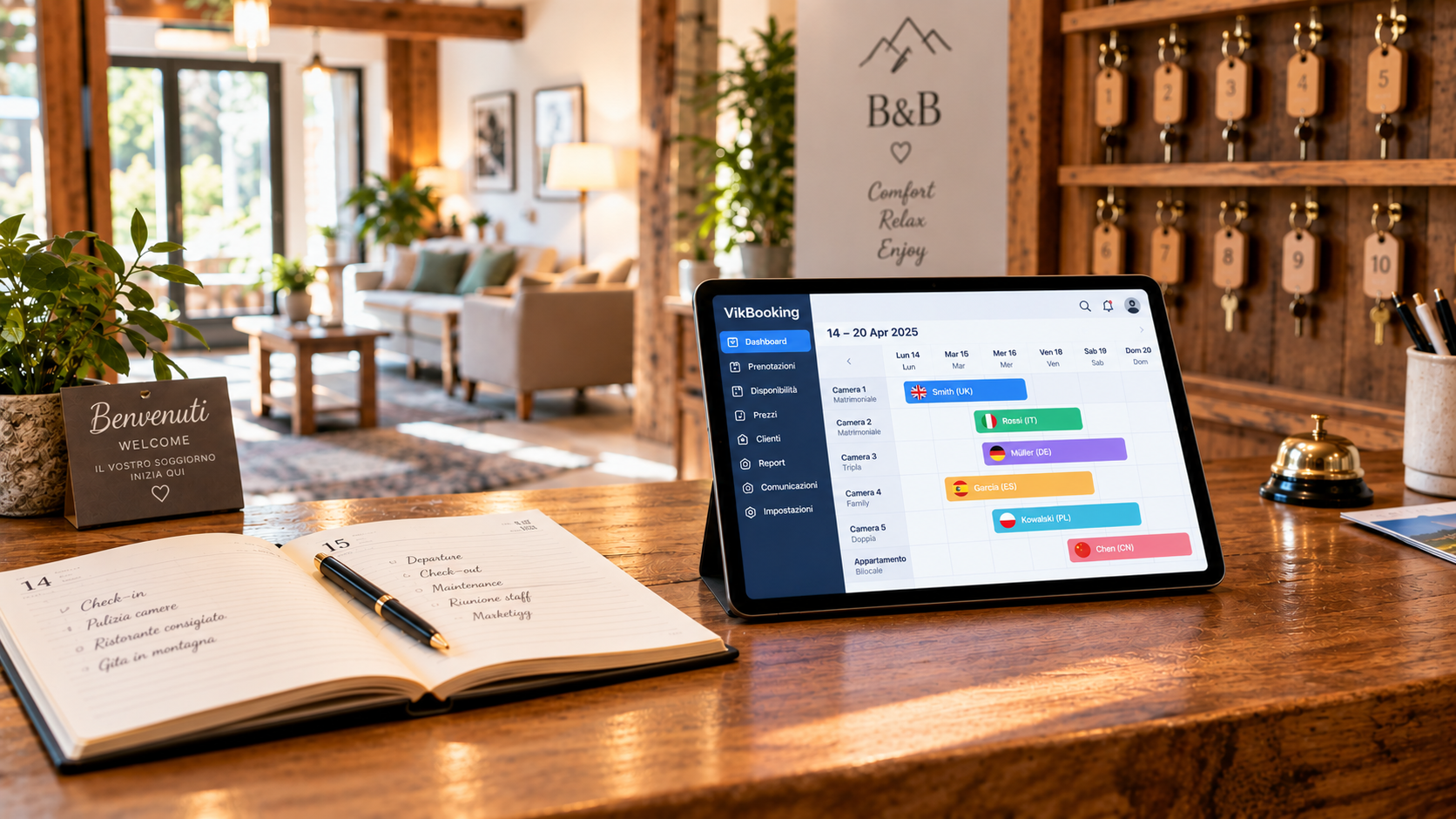
A Property Management System (PMS) acts as your operational control panel. Small bed and breakfasts do not require complex enterprise software with hundreds of sub-menus. Specialized solutions like Vik Booking offer a clean visual calendar alongside daily arrival tracking and basic guest management tools.
A solid reservation software lets you enter offline bookings, issue invoices, and manage guest preferences without adding friction to your daily workflow. Understanding how these tools interact helps you build an efficient tech stack. You can explore our article on the difference between a PMS and a Channel Manager to see how central management combines with portal synchronization.
What you can safely avoid (segmented by property size)
The hospitality software market is flooded with complex tools built for large hotels. Adopting these tools when you run a small establishment usually leads to wasted budget and unnecessary operational hassle.
The smartest way to choose your bed and breakfast software is to match your tech stack to your actual size and strategy.
Algorithmic Revenue Management Systems
Automated revenue management tools analyse weather, historical data, local competitor pricing, and demand fluctuations to change your room rates every single hour. This is effective for a 100-room hotel where shifting rates by €2 across 50 unbooked rooms drives thousands in extra yield. On a 3 or 4-room B&B, letting an algorithm constantly swing your prices confuses repeat guests and risks underpricing your peak dates without your approval.
Enterprise CRM & complex email automation
Enterprise Customer Relationship Management (CRM) tools track intricate guest profiles, automate complex pre/post-stay drip campaigns, and build multi-tiered marketing funnels. For a small B&B, your guest relationship is personal and face-to-face. A clean guest contact list within your core PMS is more than enough to send seasonal direct offers without paying for added subscription fees.
High-Frequency Dynamic Pricing tools
Adjusting your rates for seasonality and major local events is necessary, but paying for dedicated dynamic pricing software remains a low priority. Defining three or four seasonal rate tiers and tweaking prices manually for holidays gives a four-room property complete control without added software costs.
These features can serve as helpful bonuses if your core software includes them without extra charges. However, paying extra monthly add-on fees for automated rate variations, CRM or a revenue management tool is rarely worth the investment for a small bed and breakfast.
Free vs. Paid B&B Software: comparing models and hidden fees
When searching online, you will frequently come across terms like free B&B booking software. It is natural to ask whether you can run your business with zero software costs. The short answer: completely free systems almost always hide operational limitations, slow calendar syncs, or hidden per-booking commissions.
A professional bed and breakfast booking software requires stable server infrastructure and continuous updates to stay compliant with changing OTA APIs (like Booking.com or Airbnb). Therefore, your decision really comes down to two main business models:
- SaaS Cloud Platforms (Software as a Service):You pay a recurring monthly fee per room or per feature set.
- Open CMS Plugin + Channel service:You purchase a software license once and pay a small, fixed fee for real-time channel synchronization.
Here is a quick breakdown of popular European solutions (costs are based on a B&B of at least 3 rooms and are subject to change):
- Lodgify(Cloud SaaS): ~€49 – €74 / month (base annual plan). Includes a simple website builder and good channel integration. Drawbacks: Essential reporting requires higher tiers (costs can escalate to €70–€140+/month as you grow) and booking fees apply on entry plans.
- Smoobu(Cloud SaaS): ~€53 – €70 / month (Professional Plan). Features a clean interface and excellent automated guest messaging. Drawbacks: The built-in website builder is fairly basic compared to WordPress.
- Amenitiz(Cloud SaaS): Custom quote (typically ~€45–€60+/month). An all-in-one suite strong in Southern Europe with dedicated onboarding. Drawbacks: Higher ongoing monthly commitment, especially if you already own an active website.
- e4jConnect / Vik Booking(self-hosted Plugin + Channel Sync): ~€230 one-time software activation fee + ~€10–€15 / month for real-time channel sync (billed annually). Benefits: Complete data ownership, no per-booking commissions, and substantial long-term savings. Drawbacks: Requires a website running on WordPress or Joomla and basic site maintenance.
Installing software on an existing website
Integrating a booking engine into an existing website does not require rebuilding your pages or hiring an expensive development agency. Modern plugins install directly through your site administration panel with guided steps. Software like Vik Booking runs directly inside WordPress or Joomla, turning your current pages into a direct sales channel without technical complexity.
If you select a cloud SaaS provider, integration involves pasting a small booking widget code into your existing web pages. Guests select dates on your site and complete the booking process on a secure hosted checkout screen. Both methods allow you to digitize your front desk operations quickly without programming skills.
FAQ - Frequently Asked Questions
The best choice is a lightweight setup that handles direct site reservations, channel synchronization, and basic front desk operations. Small properties benefit most from self-hosted tools like Vik Booking with e4jConnect or streamlined cloud platforms like Smoobu to keep fixed monthly overhead low.
Yes, if you list rooms on more than one channel such as Booking.com and Airbnb. A channel manager closes calendars automatically across all portals in real time, preventing double bookings and eliminating manual updates.
Fully free software usually includes hidden costs like high booking commissions or slow calendar synchronization. A cost-effective approach relies on open software licenses with a single activation fee and low annual maintenance costs.
Connecting both platforms through a channel manager using direct API connections updates availability automatically. When a reservation enters from one portal, the system blocks those dates everywhere within seconds.
Owned software licenses require a one-time setup fee of around €230 plus €10 to €15 per month for channel synchronization, resulting in a total first-year cost of €350 to €410 and dropping to just €120 to €180 per year afterward. Cloud SaaS subscriptions cost between €49 and €70 per month indefinitely, making owned software significantly cheaper from the second year onward.
Yes, dedicated plugins like Vik Booking install directly into WordPress or Joomla administration panels. This turns your existing website into a direct sales engine connected to online channels without redesigning your site.