An AI agent for hospitality is an intelligent system capable of autonomously performing numerous tasks that would normally require staff intervention. In practice, it acts as a virtual receptionist able to respond to guests, retrieve information from the property management system (PMS), coordinate internal workflows, and execute operational actions.
In recent years, Artificial Intelligence has entered the hospitality sector to simplify the work of hoteliers and property managers. However, it is still frequently associated with standard systems or platforms that merely provide automated responses (chatbots).
In reality, the most advanced technologies rely on AI agents designed to execute multiple operations completely autonomously.
This is precisely the core principle behind the e4jConnect Vik Booking Artificial Intelligence framework, fully integrated with the Booking Engine and the Channel Manager: an ecosystem of specialized AI agents that collaborate with one another to support the property's daily operations.
AI Agent vs Chatbot: What Is the Difference?
A chatbot is a software program designed to simulate a conversation with a human being: it leverages Artificial Intelligence and Natural Language Processing (NLP) to understand user requests and formulate the most appropriate real-time response.
An AI agent such as the one by e4jConnect Vik Booking, does not limit itself to suggesting answers or proposing texts; it takes action on your behalf.
| Feature | Traditional Chatbot | e4jConnect Vik Booking AI Agent |
|---|---|---|
| Interaction | Responds only to pre-set text commands. | Understands the advanced context of the conversation. |
| Data Access | Limited to static answers or standard FAQs. | Real-time access to rates, rooms, and availability. |
| Operation | Suggests solutions or displays contact forms. | Takes concrete action: sends locations, creates quotes, opens doors... and more. |
Why Are More and More Properties Choosing AI Agents?
In recent years, the hospitality industry has faced new challenges: a surge in guest requests, communications scattered across multiple channels, expectations for immediate responses, and difficulties in finding qualified staff.
In this scenario, AI agents are becoming an essential tool for hotels, B&Bs, vacation rentals, residences, and campsites. By automating repetitive and operational processes, they allow the staff to focus more on hospitality and the overall guest experience.
The goal is not to replace human staff, but to support them in their daily duties, ensuring operational continuity even during night hours or peak seasons.
For this reason, AI agents are emerging as one of the most compelling tools for hospitality automation.
Not a Single Assistant, but a Team of Specialized AI Agents
The e4jConnect Vik Booking AI framework does not rely on a single, generic assistant. It functions as a team of specialized AI agents, each trained to perform specific procedures within the property. Every AI agent possesses the necessary domain knowledge to operate effectively within the hospitality context. Consequently, it can act as a virtual receptionist capable of assisting both guests and staff, retrieving data from the management system, and performing operational tasks independently.
Want to see a virtual receptionist in action?
Discover how the e4jConnect Vik Booking AI agent can respond to guests, send quotes, coordinate staff, and manage operations automatically.
How Does an AI Agent Work in Property Management?
Let's look at some practical examples.
Scenario 1: The Last-Minute WhatsApp Emergency
The Situation: A guest is driving toward your property but cannot find the address. They are stressed and send you a message on WhatsApp. You and your team are currently busy at the front desk with multiple check-ins.
What the e4jConnect AI Agent Does: It instantly recognizes the emergency, processes the context, and immediately sends the guest the exact geolocated position of the property. The guest receives an instant response without having to dig through old emails or messages. The customer feels taken care of, and you have eliminated waiting times, enhancing the guest experience and the overall perception of your service.
Scenario 2: The Locked-Out Guest
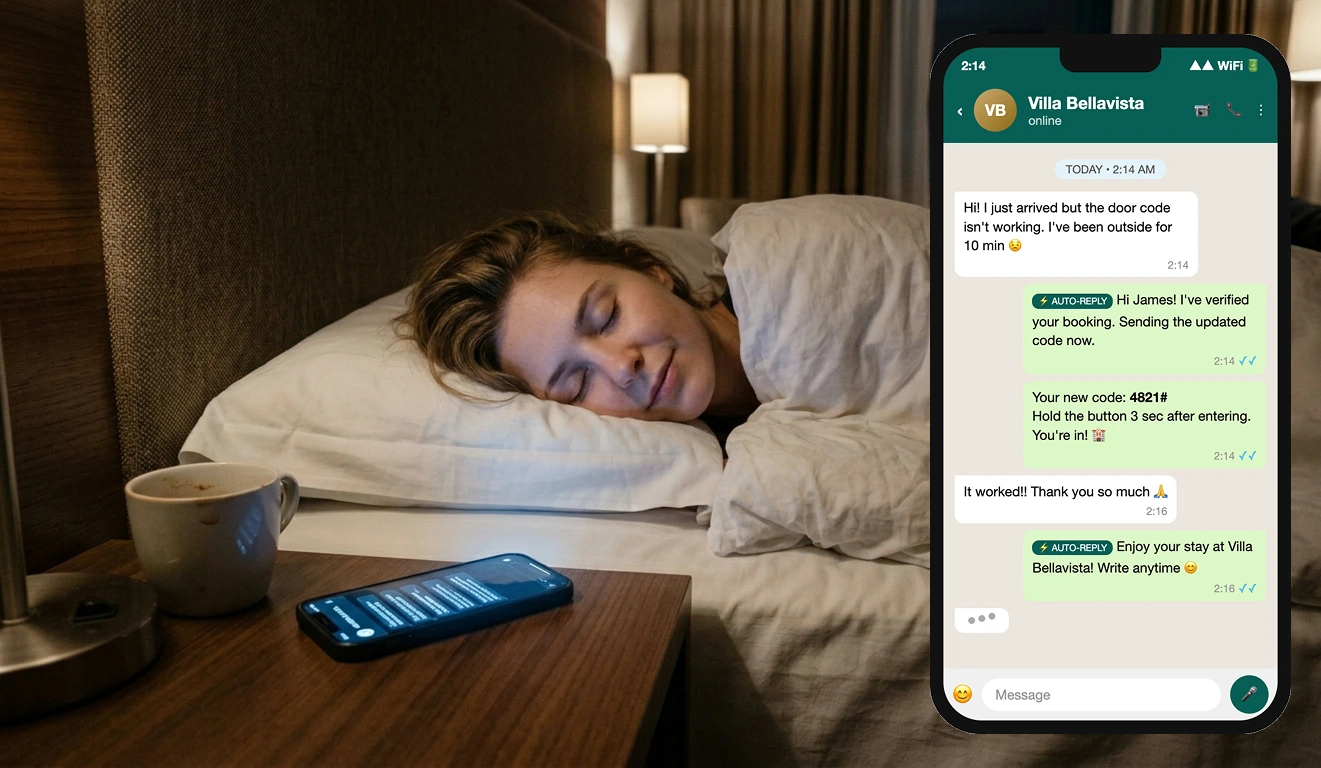
The Situation: It is two o'clock in the morning. A guest completed a self-check-in but is experiencing an issue with their smartphone or the digital key code, leaving them locked out of the apartment.
What the e4jConnect AI Agent Does: Thanks to its deep integration with the Smart Lock system (Door Access Control) and the property software, the AI agent monitors the situation in real time. If the guest reports the issue via the booking chat, the AI agent can verify the guest's identity and, when integrated with the property's access system, authorize and trigger the remote door opening. You can keep sleeping peacefully: the virtual agent resolved a critical emergency in seconds, preventing the guest from waiting in the cold and saving you a late-night trip to the property.
Scenario 3: From Quote Request to Booking, Fully Autonomously
The Situation: A customer uses the AI Chatbot on your website to ask: "Do you have a double room available from August 12th to 15th for two adults? Do you accept pets? We are traveling with a small dog.".
What the e4jConnect AI Agent Does: Most traditional chatbots would simply show a contact form. The e4jConnect Vik Booking virtual assistant, however, has full access to rooms, occupancy, live pricing, and active promotions on the system. It verifies real-time availability, calculates the correct price, and ends a detailed quote directly within the chat, while simultaneously confirming the property's pet policies and any related extra fees. If the user is satisfied, the AI agent sends the direct booking link so the customer can instantly secure their stay.
Scenario 4: Internal Staff Coordination (Automated Task Manager)
The Situation: A housekeeping team member enters a room and notices that the air conditioner is leaking water. They quickly report it in the internal chat of the Vik Booking Task Manager.
What the e4jConnect AI Agent Does: The AI agent is not just guest-facing; it also coordinates internal operations via the Task Manager. It reads the staff conversation, recognizes the nature of the issue (a technical malfunction), and automatically creates a new maintenance task, assigning it directly to the technician or the manager on duty. All of this happens without requiring you to act as an intermediary.
How Does an AI Hospitality Agent Function?
An AI agent like the one by e4jConnect Vik Booking works by connecting directly to the systems used by the hospitality property, such as the PMS, Booking Engine, Channel Manager, messaging tools, and operational software.
Therefore, its true strength lies not just in its ability to generate responses, but in its real-time access to the property's data and core systems.
As we have seen, thanks to this deep integration, an AI agent can:
- automatically respond to guests;
- verify availability and prices in real time;
- send personalized quotes;
- support check-in and self-check-in procedures;
- retrieve information directly from the management system;
- coordinate staff activities and workflows;
- manage operational requests and maintenance tasks;
- communicate fluently in multiple languages;
- automate repetitive procedures across the property.
This allows you to deliver a faster, more precise, and continuous service, while always maintaining absolute control over every action performed by the AI agent.
Conclusion: More Room for Hospitality, Less Time Spent on Repetitive Tasks
Choosing the e4jConnect Vik Booking Artificial Intelligence service means adding to your staff a team of specialized virtual receptionists, operational 24/7. This goes far beyond automating guest replies; it means delegating a concrete portion of daily workflows—which usually drain time and resources—to an ecosystem of AI agents.
Immediate Benefits for Your Property
- Maximum Efficiency: Instant answers at any hour, even when the physical front desk is closed.
- Relieved Staff: Reduced burden of repetitive tasks and significantly faster internal processes.
- Greater Operational Control: Constant monitoring of workflows and quicker handling of unexpected issues.
This allows you to finally go back to doing what you do best: welcoming your guests with the human touch that no machine can ever replace.
FAQ - Frequently Asked Questions
An AI agent for hospitality is an intelligent system capable of accessing property data, understanding guest requests, and executing tasks—such as sending quotes, retrieving data from the management system, and coordinating staff—without needing constant human supervision.
A chatbot is limited to answering questions based on text inputs. An AI agent, on the other hand, can make operational decisions and execute real-world actions without human intervention.
An AI agent like the one by e4jConnect automates numerous daily operations, including managing guest messages, sending tailored quotes, answering informational inquiries, coordinating staff, and streamlining check-ins. Through its integration with Vik Booking and Vik Channel Manager, it operates directly within your workflows, drastically reducing your staff's operational workload.
Yes. Advanced AI agents securely access real-time information within the PMS, Booking Engine, and Channel Manager to instantly fetch live availability, rates, and existing reservation details required to complete tasks independently.
Yes. AI agents are operational 24 hours a day, 7 days a week, meaning they can handle inquiries, process quotes, and manage automated emergencies even in the middle of the night.
Yes. AI agents understand and reply in multiple languages with simultaneous translation, removing language barriers and ensuring international guests feel welcome.
No. The objective is to automate repetitive, mechanical tasks so that your team can focus fully on genuine guest hospitality. Furthermore, you always retain complete control: the AI agent can be deactivated at any moment if you wish to take over a conversation personally or if a guest explicitly requests a human operator.